Item TB141
This Item was Sold on 15 December
2010 for $54
Similar artifacts for sale are often found on the Aboriginal
Boomerangs web page.
Historical Pricing information for this item and similar artifacts can be found at: Historical Artifact Prices.
|
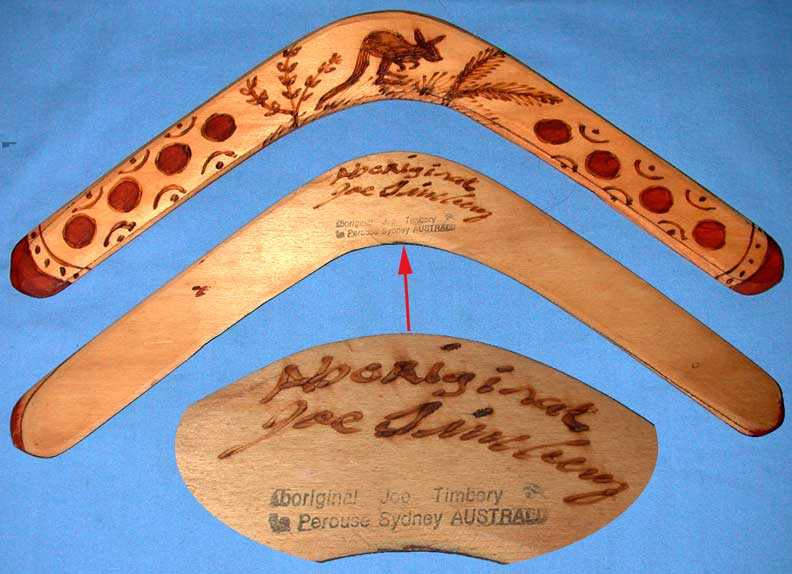
Australian Aborigines are well known for making boomerangs. The majority of Aborigines had the technology to make throwsticks, or non-returning boomerangs. Only a small percentage of the tribal groups knew how to make true returners and most of these came from the eastern coastal regions of Queensland, New South Wales and Victoria. During the past century, the majority of the Aborigines came out of the bush and were somewhat assimilated into European man's culture. Many Aborigines began making returning style boomerangs to sell to tourists. The earliest ones were well made out of natural timber and with the grain following the curvature of the boomerang. Today, most hardwood boomerang are cut out of a large board and the grain is usually straight and running parallel to a line spanning the tips of the blades. Boomerangs that are made with the grain following the contour of the blades are much stronger and more valuable. In addition, some boomerangs have good airfoiling. The majority do not. Most "tourist boomerangs" have painted upper surfaces that display Australian animals and decorative lines and/or geometric patterns. Most pre-contact returners have no artwork or the artwork is simple and scratched into the surface. It is easy to tell the tourist boomerang from the valuable ethnographic artifact. However, tourist boomerangs that are made properly with the grain running along the contour and with good airfoiling and artwork do have good collectable value, especially if they are made by famous Aboriginal artists like Bill Onus, Lin Onus or Joe Timbery. This boomerang is a medium sized returning boomerang made by Joe Timbery, one of the most famous boomerang makers of the 20th Century. Joe made boomerangs in LaPerouse, a suburb of Sydney where many Aborigines live. Joe made everything from low end tourist boomerangs for Duncan McClennan's Boomerang School in Sydney to beautiful works of art made out of fantastic natural elbows and painted like fine bark paintings. This one is made out of plywood and decorated with hot poker art depicting a kangaroo in the bush. The tips have an orange-brown stain. The airfoiling is correct for a right handed boomerang. This one is expected to be a reasonably good returner. The underside of both tips have leading edge beveling with a right handed bias. The underside of the elbow has a stamp that says " Aboriginal Joe Timbery La Perouse Sydney " and "Aboriginal Joe Timbery" is also written with a hot iron poker. This one was probably made in the 1960s. The tips are sanded flat, as was typical done on these early Timbery boomerangs. This boomerang is a good collectable in mint condition and it would display nicely on the wall. Span = 44 cm ; Weight = 68 gm |
Back to: Collectable Artifacts | Aboriginal Boomerangs | Historical Artifact Prices | Primitive Technology | contact: Ted Bailey