Item TB199
This Item was Sold on 8 July 2013
for $46
Similar artifacts for sale are often found on the South
American Artifacts web page.
Historical Pricing information for this item and similar artifacts can be found at: Historical Artifact Prices.
|
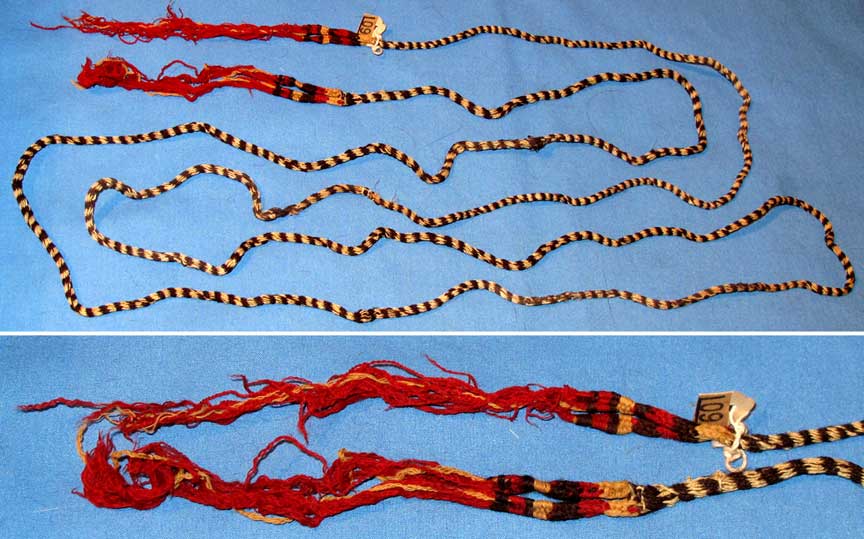
This item is a very fine and delicate Nazca tump line made out of twisted Camelid fibers with braiding at the interface between the tump line and the colorful tassels at the ends. This tumpline looks very much like a long (2.5 metre) ceremonial sling except there is no central pouch. The twisted camelid cordage is made out of tan and dark brown fibres. These fibres could be natural colors, but they are probably dyed. There is a single break in the tumpline and this has been repaired with thread. The tassel at each end is dyed royal red and braided. Very nice and unusual without the central sling pouch. It is in very good condition considering its age of 1,500 - 2,000 years. This tump was purchased in a New York City auction house in 1965 and can legally be marketed in the USA, but not exported. Provenance proving that the date of acquisition was before the 1972 import ban will be provided to the purchaser upon payment.
The Nazca ( or Nasca ) people of Sourthern Peru are the ancestors of the famous Incas. The Nazca lived in a system of valleys in what is currently Southern Peru between 200 BC and 600 AD. The Nazcas developed from the earlier Paracas culture. Since the Nazca were a coastal people who depended on the sea for their livelihood, archaeologists are fortunate that the Nazca portrayed aspects of their everyday lives in and on their pottery and textiles. Much of their art was influenced by the Moche culture. The motifs generally found on these artifacts are those of animals and plants used and seen by the ancient people. These include sea birds, hummingbirds, whales, sharks, fish, snakes, seeds, flowers, and cacti. Nazca religious art portrays a wide range of fantastic half-human, half-animal creatures, thought to be symbols of the most fearsome creatures inhabiting the earth, sky, and water. Also, more gruesomely, the Nazca portrayed disembodied heads, presumed to be trophy heads, on their pottery. The Nazca are most famous for their geoglyphs, line art located in the Nazca Desert, a high and arid plateau that stretches between the towns of Nazca and Palpa on the pampa (a large flat area of southern Peru). The Nazca plain is virtually unique for its ability to preserve the markings upon it, due to the combination of the climate (one of the driest on Earth, with only twenty minutes of rainfall per year) and the flat, stony ground which minimises the effects of the wind at ground level. The Nazca are well known for their textiles. They began using massive quantities of llama and alpaca wool a thousand years before the north coast cultures began to esteem the camelid wool. The source of the wool is believed to be from the Ayacucho region. The motifs that appeared on the pottery appeared earlier in the textiles. Textiles may have been as important to other cultures in the region as to the Nazca, but the desert has preserved the textiles of both the Nazca and Paracas cultures and comprise most of what is known about early textiles in the region. |
How to Order | Back to: South American Artifacts | Collectable Artifacts | Historical Artifact Prices | contact: Ted Bailey