Item TB273
This Item was Sold on 24 June 2015
for $35
Other collectable boomerangs for sale can be found on the
Collectable Boomerangs link.
Historical Pricing information for this item and similar collectable boomerangs can be found on the Boomerang Pricing Guide
|
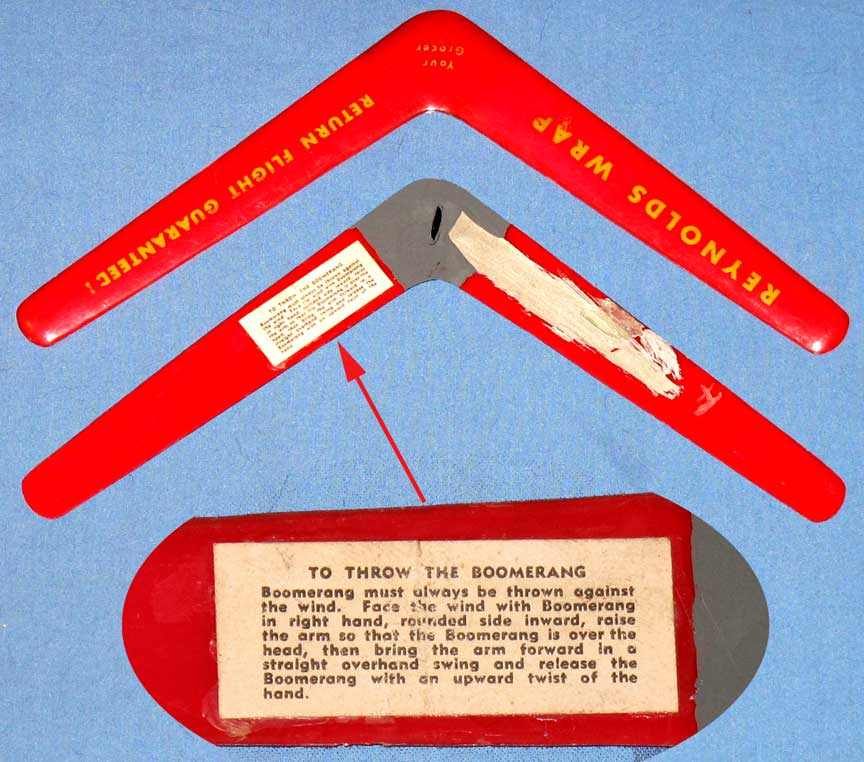
This miniature traditional boomerang is a scaled replica of the famous Frank Donnellan Whalebone traditional boomerang, made in the 1950s and distributed by grocers to customers who purchased Reynolds Wrap Aluminum foil. The plastic is red and there is gold lettering on the upper surface that says " Reynolds Wrap " and " Your Grocer " and " Return Flight Guaranteed ". The underside has silver and gray paint and a paper label with throwing instructions glued to the surface. Very rare and in very good to excellent condition. I have only seen a few of these and this one is in the best condition.
Frank Donnellan was one of Australia's earliest boomerang champions and record holders. Frank did amazing feats and he claimed to be the holder of "all records" long before there were any official boomerang clubs or sanctioned competitions. On May 4th, 1934, Frank threw a long distance boomerang of his own construction at Centennial Park, Sydney in the presenœ of "Sun" news representatives. The boomerang circled a pole 140 yards away and then it was caught on the return. This, and other feats included throwing over Watson's Bay Gap one hundred yards over the water and caught on the return and throwing off the "Sun" Office Buildings seventy-five yards out over the city, and caught on the return. Frank made and sold boomerangs well into the 1950s. His commercial models were constructed out of plywood and his long distance models were constructed out of Whalebone, a composite material similar to Paxolin, but made out of pressed whale baleen and wood products. Whalebone was used by the railroad companies to line the inside of railroad box cars for shock absorbing purposes. Frank obtained his whalebone material by jumping into empty box cars as trains passed by his home and he would then rip out a sheet and take it home to make his long distance boomerangs. Frank's commercial boomerangs were plentiful in the 1940s and early 1950s, but they have become quite scarce and they are hard to obtain by contemporary collectors, especially in mint condition. |
How to Order | Back to: Boomerang Catalog | Collectable Boomerangs | Boomerang Pricing Guide | contact: Ted Bailey